
FULL ACCESS to the 'MoveMore: VRL'
$55 a month or $495 a year
Become a member of the 'MoveMore: Video Resource Library (VRL)' via monthly or yearly subscription and begin GROWING your Movement Practice. Subscribers gain access to:
.
📺 800+ immaculately detailed video resources containing THOUSANDS of contexts for practice. Includes all future updates.
📝 Supporting essays & videos clarifying the WHAT & HOW + how to PROGRAM your practice
🌲 Extensive SKILL TREES with 'milestones' to direct & guide capacity & skill-development
🌎 Access to community 'Forums' for engagement, discussion, Q&A and "troubleshooting" in practice
🗺️ A clear "mapping" of Movement Practice across parent categories & sub-theme collections
♾️ Exposure to interconnected concepts & principles informing a wider 'Movement perspective'
.
A unique physical-education platform, the 'VRL' is designed for self-directed use by movement professionals, teachers, coaches, practitioners, and enthusiasts alike. It provides guidance, yet freedom, to design progressive pathways according to the goals, experience, and interests of the individual with the objective of nurturing & growing sustainable Movement-practice.
-
 9 videos
Breathing-forms
9 videos
‘Breathing forms’ create a space for the cultivation of somatic awareness, allowing the practitioner to explore, in an embodied way, the intrinsic relationship between breath and movement. Every breath elicits a natural wave through the body, transmitting through the spine and into the extremitie...
-
 5 videos
Core-elasticity
5 videos
Core elasticity focuses on the ability of the trunk and spinal system to absorb, store, and re-express force through the stretch-shortening cycle, acting as the central transmission bridge between upper and lower body. While described as “core,” this quality is never isolated, but instead express...
-
 14 videos
Ground-acro shapes & synergies
14 videos
This collection develops ground-acrobatic shapes and synergies through the use of referent configurations (zero points) - stable structural positions from which movement is organised, expressed, and transferred. These configurations act as anchors within the system, allowing the practitioner to b...
-
 10 videos
Ground-acrobatic skills
10 videos
This collection develops a broad range of ground acrobatic skills, forming a mixed but interconnected vocabulary of inverted and transitional movement patterns. These skills are built upon shared referent configurations and synergies, such as the explosive hip-thrust, reverse-hinge, forward-hinge...
-
 11 videos
Integrated ground-acro & FA
11 videos
'Integrated ground acrobatics and free-association' practice brings together previously separate acrobatic skills, shapes, and synergies in continuous movement expression. Rather than isolating individual techniques such as cartwheels, handstands, or 'Chapeau de couro' variations, the focus shift...
-
 4 videos
'Momentum walks'
4 videos
‘Momentum walks’ are a dedicated collection of connective locomotor pathways that function as the transitional infrastructure between acrobatic skills. Rather than being isolated techniques themselves, they operate as dynamic linking structures that organise how momentum is generated, redirected,...
-
 7 videos
Cartwheels
7 videos
This collection develops cartwheel-based ground acrobatic vocabulary, one of the most accessible yet deceptively rich entry points into dynamic inversion and spatial coordination. While often perceived as a single fundamental pattern (typically the ipsilateral cartwheel), the cartwheel actually c...
-
 7 videos
Jumping & rebounding
7 videos
This collection develops the ability to absorb, redirect, and re-express force through elastic jumping mechanics, focusing on cyclical interaction with the ground and environment. Unlike linear jumping patterns, this work emphasises continuous force recycling, where landing is not an endpoint but...
-
 10 videos
Jumping: vertical, broad & staircase
10 videos
This collection develops jumping as a directional displacement skill within environmental communication, organised through three primary trajectory modalities: vertical, broad (horizontal), and staircase-based movement. Each modality expresses a different relationship to space, force, and ground ...
-
 6 videos
Jumping & landing mechanics
6 videos
This section develops the foundational layer of jumping and landing within environmental communication, focusing on the precise coordination of take-off, flight organisation, and controlled force absorption upon impact. It establishes the mechanical base through which more complex displacement, r...
-
 7 videos
High rail-work
7 videos
This collection develops high rail work, referring not to the height of the rail itself but to the higher positional level of the body in space, typically in upright standing orientations above the rail. As a distinct spatial level from low rail work, it introduces a balance environment where the...
-
 8 videos
Low rail-work
8 videos
'Low rail-work' refers not to the height of the rail itself, but to the lowered position of the body in space, typically in squat or quadrupedal orientations. As opposed to high rail work (standing positions), this context places the centre of mass closer to the rail, making it the most accessibl...
-
 4 videos
Integrated rail-work & FA
4 videos
In 'Integrated rail work and free-association (FA)' practice, the distinct levels of rail-communication - low (squat, quadrupedal), high (upright standing), and transitional patterns between them - are brought together into a single continuous movement system. Rather than working isolated pattern...
-
 6 videos
Foundational wall-strength
6 videos
This collection develops the foundational strength and contact capacities required for effective wall communication, focusing on basic but essential hanging, support, and load-bearing positions on and around wall structures. It provides the physical base that allows more complex overwall, underwa...
-
 7 videos
Under-wall work
7 videos
This collection develops the practitioner's foundational experience in wall-communication, shifting from static strength contexts into more dynamic patterns of displacement, coordination, and structural organisation beneath the surface line of support. It builds on foundational wall strength by a...
-
 7 videos
Over-wall work
7 videos
This collection develops locomotor and transitional movement across the top surface of wall structures, shifting wall communication away from hanging-based strength contexts into upright and semi-upright displacement, balance, and traversal in elevated environmental conditions. It focuses on the ...
-
 5 videos
Integrated wall-work
5 videos
Contexts in this collection bring together the full spectrum of wall communication by linking ‘Under wall-work’ and ‘Over wall-work’ into a single, continuous movement vocabulary. Rather than treating these as separate environments, the focus shifts to how the body can move across, between, and t...
-
 16 videos
Quadrupedal patterns & conditioning
16 videos
THE WHAT:
The practice of ‘quadrupedal-locomotion’ is most generally concerned with movement through space on “all-fours”, sharing weight between both the feet AND the hands. In comparison to BI-pedal patterns, then, this is certainly not a natural way for humans to locomote, and, in trying to lo... -
 4 videos
Upper-body elasticity
4 videos
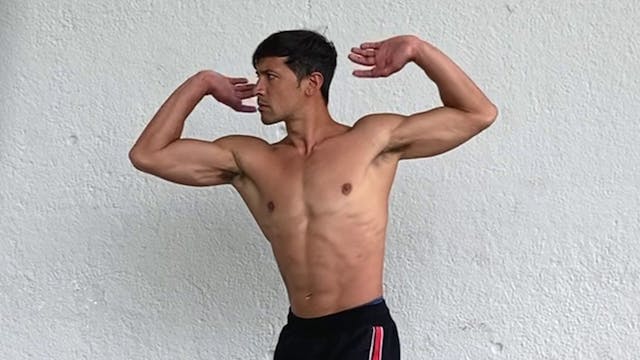
Upper body elasticity focuses on developing the ability of the arms, shoulders, chest, and upper kinetic chain to absorb, store, and re-express force through the stretch-shortening cycle, while maintaining shoulder integrity and efficient force transmission through the upper system. The emphasis ...
-
 9 videos
Gross & fine motor-control
9 videos
These types of practices sit within coordinative training because they force the practitioner to manage control, stability, and precision under changing task demands, rather than simply producing force or repeating fixed movement patterns. The use of objects like sticks and balls introduces a con...
-
 0 videos — 9 extras
UBS skill-trees .pdf's
0 videos — 9 extras
Skills trees for UBS / BAS, SAS, SASS (Levels 1-4) in .pdf format, directly linked to the VRL. Open download below:
UBS / BAS (L1): https://drive.google.com/file/d/1JQ2vWtiGxRllXMTUZxIfZkdk0bQhWuOv/view?usp=drive_link
UBS / BAS (L2): https://drive.google.com/file/d/1RJ70zcyCd8JZwBPXDfAtgXGJOfP1x... -
 0 videos — 4 extras
LBS skill-trees .pdf's
0 videos — 4 extras
Skills trees for LBS (Levels 1-4) in .pdf format, linked directly to the VRL. Open download below:
LBS (L1): https://drive.google.com/file/d/14-tBc-ph59Ioox97W_P8sr0RFBmbrKTT/view?usp=drive_link
LBS (L2): https://drive.google.com/file/d/1kTLEDpz0D24p4rtZo6ICeU3DzsmH6xGC/view?usp=drive_link
LBS (... -
 29 videos
Lower-body elasticity
29 videos
Lower body elasticity focuses on developing the ability of the legs and lower kinetic chain to absorb, store, and re-express force through the stretch-shortening cycle. The emphasis is on creating efficient rebound through the feet, ankles, knees, and hips while maintaining structural integrity u...
-
 1 video
Open-form: Legs
1 video
COMING SOON
-
 2 videos
Open-form: Spine
2 videos
COMING SOON
-
 1 video
Open-form: Arms
1 video
COMING SOON
-
 8 videos
Headstands
8 videos
This collection develops the headstand (HeSt) as a complete and adaptable inversion system, progressing from foundational stability toward dynamic, integrated ground-acrobatic expression. Beginning with static balance and controlled pressing forms, the practitioner establishes structural clarity,...
-
 14 videos
Temporal and structural coordination
14 videos
THE WHAT:
These practices sit within temporal and structural coordination, involving movement contexts which both request and develop subtle and interconnected attributes of timing, rhythm, and coordinative organisation. Whether the body is moving through space alone or in interaction with an ext... -
 11 videos
S&S: local & integrated patterns
11 videos
This collection develops ‘local’ and ‘integrated’ spinal patterns, forming the foundational layer of spinal-work through which spinal literacy is first established. Here, movement is approached at the level of specific regions of the spine - cervical, thoracic, and lumbar - using identifiable pat...
-
 16 videos
S&S: 'Global' patterns
16 videos
This collection develops ‘global spinal patterns’, where the spine is expressed as a unified, coordinated system rather than as discrete regional segments. Unlike local or integrated work, which builds control through differentiation and combination, global patterns emphasise the spine as a conti...
-
 21 videos
Core & spinal-stability
21 videos
This collection develops core and spinal stability as a central conduit for force transmission through the body, supporting coordinated interaction between upper and lower segments under load. Rather than isolated core work, the emphasis is on the spine’s role in organising, transferring, and res...
-
 4 videos
'In Focus' Programming: Handstand
4 videos
-
 8 videos
Handstand entry & exit
8 videos
Before being able to balance in a handstand, you must learn to enter. Generally an certain entrance is chosen because it is conducive to the specific balancing form which follows. E.g. a straight-leg kick-up into straight-line allows for immediate alignment of the legs, as well as travelling the ...
-
 11 videos
Handstand alignment drills
11 videos
Before taking to inversion, we first need to begin developing an embodied understanding of the form which we will ultimately practice bringing to balance. Handstand alignment drills are therefore not only integral to the beginner's practice (and should be heavily invested in), but will also serve...
-
 13 videos
Handstand supported-alignment
13 videos
At the same time as managing mobility restrictions and developing an understanding of the fundamental structure of an "aligned" handstand, you can immediately begin to build experience in an inverted position by practicing 'supported-alignment' drills. This is where we first begin to approach and...
-
 10 videos
Handstand supported-balance
10 videos
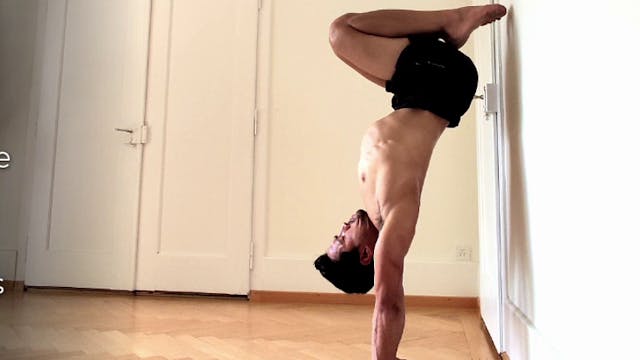
Once a fundamental understanding of 'alignment' and structural awareness in straight-line and tuck forms and a foundational capacity for holding in inversion has been developed, the ongoing work of "finding" balance can commence. Whilst for those with existing experience in inversion (whether sta...
-
 15 videos
Handstand balance contexts
15 videos
These handstand-balance contexts provide years of practice toward developing both linear (i.e. extending the capacity for time in balance) and lateral (exposure to a range of contexts) experience in the two-arm handstand. As well as exploring different forms and leg positions which serve to heigh...
-
 21 videos
Press HS & Stalder press
21 videos
Whilst fundamentally dependent upon the ability to balance in a handstand and an embodied understanding of the structure and mechanics required to do so, ‘Press-handstand’ variations and the ‘Stalder press’ ultimately belong to the bodyweight practice of ‘straight-arm scapular/strength’ (SAS/S) p...
-
Floor-entrance (FEN) & floor-exit (FEX) patterns
18 videos
As a loosely applied-term, ‘floor-entrance’ (FEN) and ‘floor-exit’ (FEX) describes patterns and sequences which transition through “levels” in space toward the floor. Whilst some move simply from standing (bipedal) to quadruped (i.e. to contact with the hands also), others descend into full floor...
-
 12 videos
Floor-contact locomotion & transitions
12 videos
In order to develop an interconnected & usable vocabulary of floor-contact locomotion, further to the availability of floor-entrance & floor-exit (FEN/FEX) patterns the attention necessarily shifts to developing movement optionality once the practitioner is on the floor. Quite simply, we begin wi...
-
 7 videos
Floor-contact sequence & impro
7 videos
Having learnt certain isolated patterns and “floorwork” concepts, the space opens up to begin putting them together and truly “driving” the body through space, in floor-contact. Whilst this can be undertaken at any stage of practice and should not be dressed in the guise of some “ultimate level”,...
-
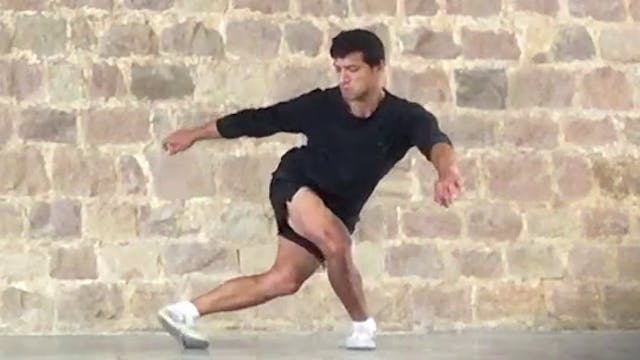 22 videos
Bipedal patterns & conditioning
22 videos
THE WHAT:
The practice of ‘bipedal-locomotion’ is most generally concerned with movement through space, on two legs. Beyond the gradations between walking and running, however, the legs have the potential to move in more “complex” ways than this alone, opening up a subject of practice in which a ... -
Locomotion integration, sequences & impro
17 videos
This collection of resources presents just a few possibilities of ‘bipedal’ & ‘quadrupedal’ locomotion integrations, with an eye toward developing an “embodied” proficiency to express them whilst moving “freely” (i.e. at the practitioner’s own will and direction) through space – i.e., ‘improvisat...
-
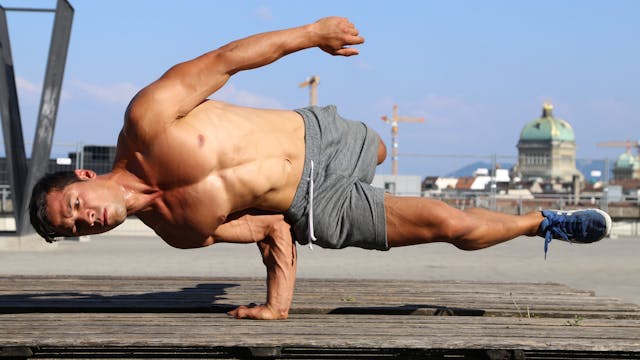 15 videos
Groundwork patterns & conditioning
15 videos
THE WHAT:
‘Groundwork’ outlines an area of floor-communication characterised by transitions & locomotion patterns which oscillate, in, out of, and through the ‘squat’ form whilst innately shifting weight between the hands & feet. This area differs from ‘quadrupedal-locomotion’ firstly in that it ... -
 16 videos
Groundwork integrations
16 videos
THE WHAT:
Whilst ‘integrations’ are present in both areas of ‘Locomotion’ and ‘Floorwork’ aspects of the greater ‘Floor-communication’ category, in the practice of ‘Groundwork’ they are deserving of a collection entirely to themselves. This is because, unlike their aforementioned counterparts, th... -
 9 videos
Groundwork sequences & impro
9 videos
Whilst, as with other areas of ‘Floor-communication’ practice, the quality of individual patterns and connected integrations can continually be developed in the practice of extended sequences and even during improvised contexts, in an ideal scenario this requirement should be MINIMAL. Rather, the...
-
 21 videos
RE-/PREHAB: Shoulders, scap & neck
21 videos
WHAT YOU NEED & WHAT YOU DON’T:
As with other ‘Re-/prehab’ collections, there is some resource-crossover with collections concerned with capacity & strength-development, such as ‘Fundamental hanging’ contexts in the practice of straight-arm scapular-strength (SASS) development, or with patterning... -
RE-/PREHAB: Fingers, wrists. forearms & elbows
20 videos
The arms & hands function as our body’s physical “manipulators”, allowing us to interact with our environment and the objects within it in a range of complex ways. As with the shoulder, this “complexity” is represented in freedom to move and affords both the wrist-articulation, and therefore hand...
-
 22 videos
PRE-/REHAB: Feet, ankles, knees & hips
22 videos
In establishing our verticality under the constant of gravity, the base and initiation of all movement from our standing position is expressed in the connection of our feet, to the floor. Even restrictions in the range of toe-extension, then, can influence and are influenced by the state of conne...
-
Manual-therapy & self myofascial-release (SMR)
13 videos
Fundamental resources for diagnosing, treating, and mitigating hypertonicity in areas of the body which can commonly hold a greater than desirable level of resting tone. Whether from lifestyle or practice habits, if left untreated, what can begin as "superficial-blockages" affecting the muscles &...
-
 22 videos
Shoulder-mobility (range-development)
22 videos
A “COMPLEX” SUBJECT:
Restrictions to the range of shoulder-movement, and therefore developing them, can be as complex as the shoulder-articulation itself; relative to the ball & socket joint of the hip, for example, the humeral-head (i.e. of the upper-arm) sits extremely shallow in the glenoid fo... -
 12 videos
BW 'front-folding'-range
12 videos
‘Front-folding’ is a form in which the body is maximally flexed in the hips & lumbar-spine, so as to “pull” the upper-body & face maximally toward the shins. It is more distinguishable as the feet-TOGETHER ‘Pike’ form, as opposed to the STRADDLED legs of the ‘Pancake’, as whilst the latter does “...
-
 18 videos
Weighted mobility development
18 videos
'Weighted' mobility development contexts utilise an external load to help enter end-ranges of motion and develop strength there. Whilst they are generally dynamic (i.e. moving in & out of the end or through the full range with both a concentric and eccentric phase), loaded static forms (e.g. 'Hor...
-
Fundamental squat & hip-mobility development
23 videos
The phrase “fundamental human-ranges” is not one thrown around so lightly as, despite the potential to invest in a variety of forms for mobility-development (from ‘global-extension’ & ‘front-folding’ to ‘leg-abduction’ & ‘compression’), few of these are so integral a range to natural movement pot...
-
 18 videos
'Bridging' & global-extension
18 videos
These contexts are collectively concerned with mobility-development in the general range of ‘global-extension’, effectively referring to the potential of the full-body (i.e. ‘global’) structure to extend backward and sustain this form with intrinsic STRENGTH. Whilst this is simultaneously the wor...
-
 16 videos
'Compression' mobility-development
16 videos
‘Compression’ describes the capacity to actively pull, or “compress”, the legs closer to the torso. As such, it is an innately ‘OPEN kinetic-chain’ context, meaning that the extremities doing the “work” (i.e. the leg/s) are free to move in space. Another perspective is of “closing the gap” betwee...
-
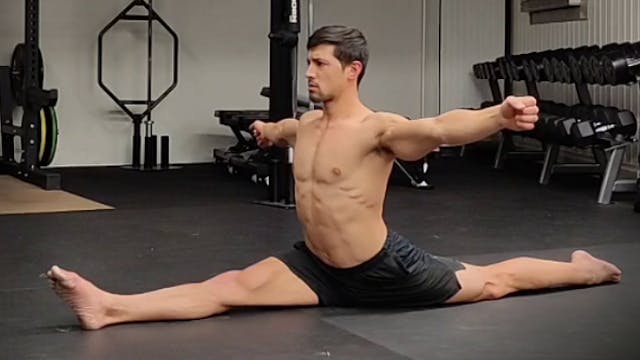 13 videos
BW leg-abduction range & forms
13 videos
‘Leg-abduction’ ranges are those in which the legs move AWAY from the mid-line of the body, namely ‘Front-splits’ forms (leg-abduction in the sagittal-plane) and ‘Middle-splits’ forms (in the frontal-plane). Included are also ‘Pancake’ forms which, whilst subject to ‘middle-split’ range, also rel...
-
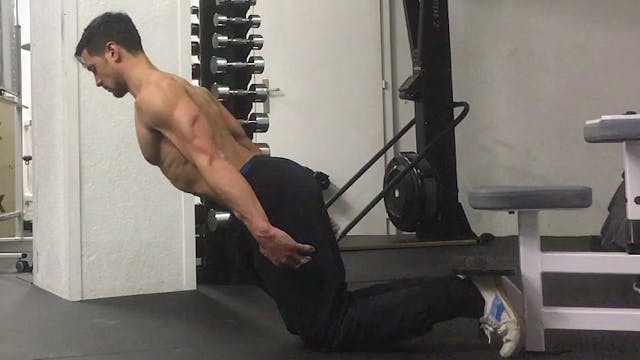 14 videos
Bodyweight (BW) bilateral leg-strength
14 videos
In considering bodyweight (BW) training for the lower-body, the vocabulary of possible strength-development tools, even for the “trained” individual, is often far more limited than those for weighted/resisted contexts. Beyond bilateral bodyweight squats, even the Calisthenics enthusiast will ofte...
-
 16 videos
Bodyweight (BW) unilateral leg-strength
16 videos
In considering bodyweight (BW) training for the lower-body, the vocabulary of possible strength-development tools, even for the “trained” individual, is often far more limited than those for weighted/resisted contexts – defining further to the range of UNILATERAL (“single-legged”) contexts, then,...
-
 17 videos
Weighted strength-development
17 videos
DISTINCTIONS IN STRENGTH:
This collection presents foundational weight-training contexts for the purpose of cultivating experience with ‘intensity’ toward the development of maximal strength. They are based around fundamental loading-patterns and, other than some additional “isolated”/‘open kinet... -
 10 videos
BAS pull (vertical)
10 videos
Most generally, bent-arm strength (BAS) in vertical-pulling is ultimately the practice of displacing the body upward in space from an anchor-point, maintained in connection with the hands. Whilst the modality might change (here only bar, rings, and rope are explored), this collection proposes two...
-
 12 videos
BAS pull (horizontal)
12 videos
In most cases, investment in the world of horizontal-pulling is initially concerned with development of fundamental neuro-muscular efficiency, or “NEURAL-DRIVE”, in the scapular-musculature. As with ‘SASS pull’ contexts, which emphasise development of scapular-retraction/depression under load (or...
-
 12 videos
BAS push (vertical)
12 videos
Bent-arm strength (BAS) pushing in the vertical-plane allows for TWO DIRECTIONS of force-production: DOWNWARD, from a “support” position (i.e. bodyweight supported in the hands on rings, boxes, bars…), and OVERHEAD, with the body maintained in an inverted position. Whilst this then calls for two ...
-
 17 videos
BAS push (horizontal & lateral)
17 videos
This collection of resources initially sets out to teach the practitioner transferable forms, mechanics, and execution for efficient bent-arm strength (BAS) pushing in the horizontal & lateral planes, establishing in the process a strong baseline of foundational strength-capacity. From here the p...
-
 17 videos
SASS push (vertical & horizontal)
17 videos
The straight-arm scapular-strength (SASS) ‘push’ collection develops the foundational understanding, patterning, and capacity on which to build the mechanics of straight AND bent-arm pushing through a progressive pathway. Whilst the function of the scapulae in SASS hanging/pulling contexts this i...
-
 13 videos
SASS pull (vertical & horizontal)
13 videos
The straight-arm scapular-strength (SASS) ‘pull’ collection develops the foundational understanding, patterning, and capacity on which to build the mechanics of straight AND bent-arm pulling through a progressive pathway. If the hands are one end of the pulling chain connecting arms to an anchor-...
-
 11 videos
SAS push (horizontal)
11 videos
When supporting bodyweight with the hands on the floor, as soon as an ANGLE is created between the torso & arms OR the arms “lean” out of a position of vertical support, there is increased LEVERAGE around the fulcrum (here the joints of the shoulders & wrists) and with it an increase in INTENSITY...
-
 15 videos
SAS pull (horizontal)
15 videos
When pulling from a hanging position/lowering from an inverted-hang with straight-arms (SA), the body changes orientation in space (closed kinetic-chain movement) toward HORIZONTAL. This is regardless of whether working in SA flexion, e.g. ‘Front-lever (FL)’ or extension, e.g. ‘Back-lever (BL)’. ...
-
 16 videos
Integrated BAS/SAS & Skills
16 videos
Once both an embodied understanding of and general capacity with foundational strength contexts on the rings (e.g. ‘Pullups’, ‘Dips’, ‘L-sit/ring-support’ and ‘Bent-arm support’) has been developed, the next step in is bringing them together in foundational integrations.
Whilst this is a gradual...
-
 10 videos
'Rings' sequences & routines
10 videos
Integrating strength & skill contexts on the gymnastics rings into extended sequences & routines is a simple way to develop further “complexity” in an upper-body strength practice. Notably, the work is now oriented around transitioning one’s body through a greater range of different forms, positi...




-
FULL ACCESS to the 'MoveMore: VRL'
Become a member of the 'MoveMore: Video Resource Library (VRL)' via monthly or yearly subscription and begin GROWING your Movement Practice. Subscribers gain access to:
.📺 800+ immaculately detailed video resources containing THOUSANDS of contexts for practice. Includes all future updates.
📝 S...
